
Tags
For days, stopping at one container yard after another, I had been yearning for Tahiti. I am plowing through Hampton Sides’ book, The Wide Wide Sea, about Captain Cook’s 18th-Century explorations of the South Pacific. His crew, grimy and horny, always looked forward to Tahiti with its wild exotic flowers, cooling waterfalls, fresh fruit, and half-naked girls. Besides, our ship was running low on fresh fruit, and Tahiti has the best pineapples ever.
During a solo exploring walk around Papeete (read: shopping) I discovered French stores and sidewalk cafés with their menus chalked onto an ardoise as they do in France. Street vendors sold jewelry made of shells, tie-dye fabric, and crowns of flowers that cover a multitude of bad hair days. I enjoyed trotting out my rusty French, which I will do at the drop of a croissant.
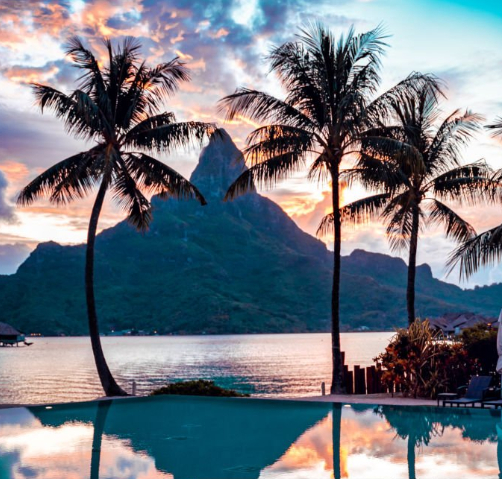
Like many of the 118 islands that comprise French Polynesia, when seen from the water this one is shaped like a Hershey’s kiss, with a central volcano cloaked in green, and an oceanfront road all around the waterline where most of the people live. The island’s big selling point is rain that tumbles down from the top of the old volcano, finding its way to the ocean. En route, it finds a way to encourage giant tropical flowers, trees, exotic ferns, plus fruit and avocados.
Tom and I climbed aboard a blissfully air-conditioned bus for a tour of Tahitian hot spots. We saw a grotto carved out of a lava mountain where — surprise — gorgeous young Tahitians splashed about in four feet of spring water that we never suspected was there. The next stop was a traditional site of post-death purification, called a marae, a lovely and probably haunted meadow with ponds and waterfalls where souls were allegedly examined and cleansed after death, and then sent off to a pleasant netherworld.

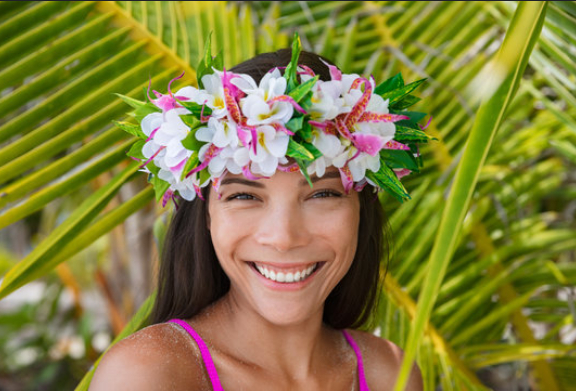
Native Tahitians had lovely spiritual beliefs before the arrival of Europeans, who passed on diseases, built churches, made everybody speak French instead of Tahitian, but failed to quash the proud people in bright pareos and flower crowns (see photo, top of this post). Still it was moving to visit Venus Point, where the early explorers — Wallis, Bougainville, Bligh, Cook — all landed in Tahiti for the first time. It is now a public beach where families were gathered for picnics, ukulele strumming, and races across a narrow beach for a plunge in the warm ocean. (Tahiti is typically 82 Fahrenheit year-round, and the ocean is the same temperature.)
The beaches may be free, but not much else is. Tahiti produces coconut oil, flower oil, fruits, vegetables, textiles, and shell art; but groceries, toiletries, and cars are imported at great expense. Our guide told us that Tahiti is one of the most expensive places to live in the world, and Tahitians sometimes move to Hawaii to save money. In Hawaii we learned that Hawaiians move to Las Vegas to save money. So Tom and I are probably not going to resettle in Tahiti after all, although I just might try to launch the flower-crown thing in Portland. In Oregon it’s almost a birthright to malign the rain, but maligning anything — rain included — is irreverent when you have exotic flowers in your hair. Just ask a Tahitian.
###
 The Expat Almanac
happy to consider a flower crown at my swearing-in ceremony.
delightful, informative post!
olivia (from Seattle Thksgvg)
LikeLike
You may count on it! We’re so proud of you!
LikeLike